AI Agents vs. Chatbots: What’s the Difference and Why It Matters
AI chatbots answer questions, while AI agents take actions. Learn the key differences, architectures, use cases, and why this distinction matters for modern AI-powered products.
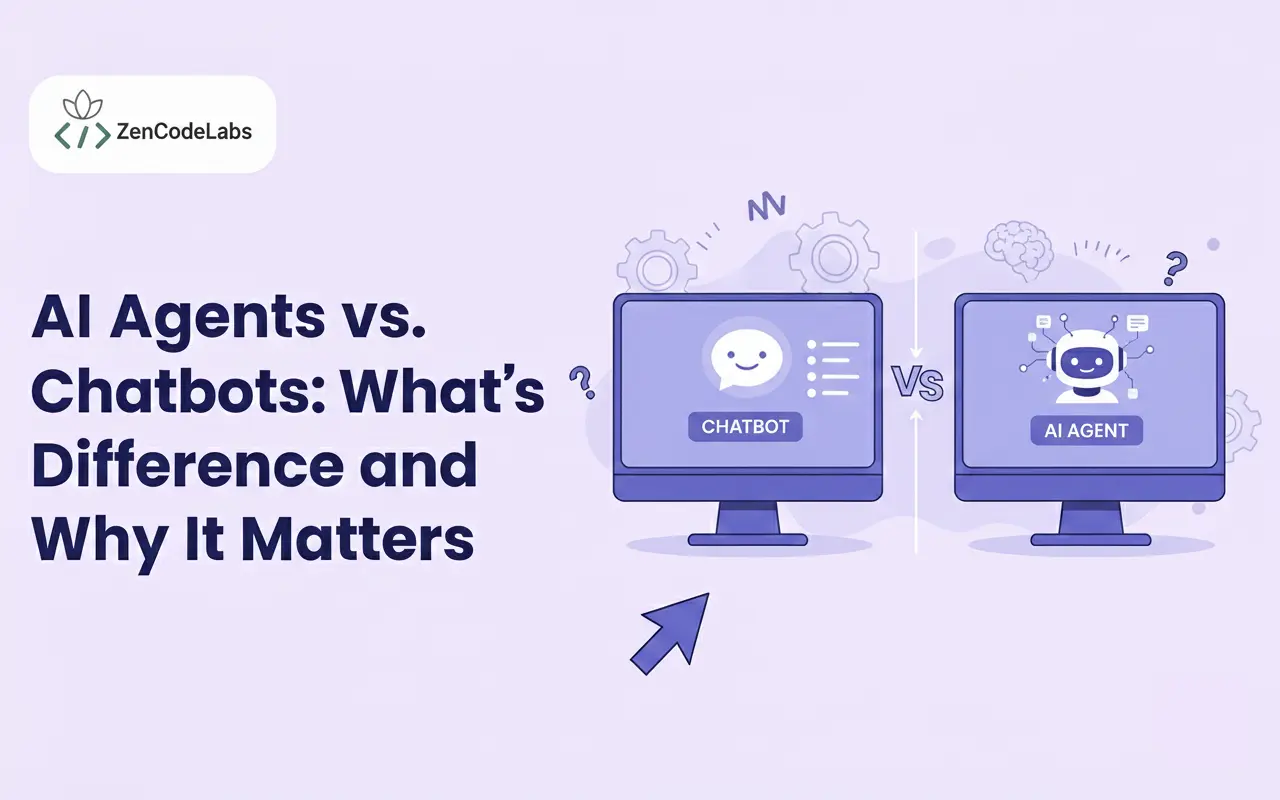
Table of Contents
- Why This Distinction Matters
- What Is a Chatbot?
- What Is an AI Agent?
- Key Differences at a Glance
- Architecture Comparison
- Real-World Use Cases
- When a Chatbot Is Enough
- When You Need an AI Agent
- Product, Cost, and Risk Implications
- The Future: From Chat to Action
- Final Thoughts
Why This Distinction Matters
“AI chatbot” and “AI agent” are often used interchangeably — but they represent very different product paradigms.
Misunderstanding this difference can lead to:
- Over-engineered systems
- Unexpected AI infrastructure costs
- Security and compliance risks
- Poor user trust and UX
As AI evolves from conversation to execution, choosing the right approach becomes a strategic decision — not just a technical one.
What Is a Chatbot?
A chatbot is a conversational system designed to respond to user input.
It is fundamentally reactive.
Typical Chatbot Capabilities
- Answering questions
- Explaining concepts
- Summarizing text
- Guiding users through flows
- Providing recommendations
Chatbot Flow Diagram
User Prompt
     │
     ▼
Chat Interface
     │
     ▼
LLM / NLP Model
     │
     ▼
Text Response
Once the response is generated, the chatbot’s job is done.
What Is an AI Agent?
An AI agent is a system designed to achieve a goal, not just answer a question.
Agents can:
- Understand intent
- Break goals into tasks
- Use tools and APIs
- Observe results
- Adjust behavior
- Act autonomously within defined limits
AI Agent Flow Diagram
User Goal
   │
   ▼
Intent Understanding
   │
   ▼
Task Planning
   │
   ▼
Tool Selection (APIs, DBs, Services)
   │
   ▼
Action Execution
   │
   ▼
Observation & Feedback
   │
   └──► Repeat Until Goal Is Met
Unlike chatbots, agents operate in loops, not single turns.
Key Differences at a Glance
| Feature | Chatbot | AI Agent |
|---|---|---|
| Core purpose | Respond to queries | Achieve goals |
| Behavior | Reactive | Proactive |
| Autonomy | Low | Medium to high |
| Memory | Stateless or limited | Persistent |
| Tool usage | Optional | Essential |
| Risk level | Low | Higher |
| Best for | Q&A, support | Automation, workflows |
Architecture Comparison
Chatbot Architecture
UI → Prompt → LLM → Response
- Simple
- Predictable
- Low cost
- Easy to monitor
AI Agent Architecture
UI / Trigger
   │
   ▼
Goal Parser
   │
   ▼
Planner
   │
   ▼
Tool Registry
(API, DB, Services)
   │
   ▼
Execution Engine
   │
   ▼
Memory + Logs + Safety Rules
Agents require orchestration, permissions, and monitoring, not just model inference.
Real-World Use Cases
Chatbot Use Cases
- Customer support assistants
- Documentation search
- Onboarding helpers
- Educational tutors
- Content Q&A bots
AI Agent Use Cases
- CRM automation
- Sales and email follow-ups
- DevOps monitoring and remediation
- Data analysis and reporting
- Personal productivity assistants
When a Chatbot Is Enough
A chatbot is the right choice when:
- Users initiate every interaction
- No real-world actions are required
- Errors must be harmless
- Predictable costs matter
- You’re building an MVP
Most AI features should start as chatbots.
When You Need an AI Agent
You should consider an agent when:
- Tasks require multiple steps
- Automation saves time or money
- Context must persist over time
- The system acts on behalf of users
- Human-in-the-loop oversight is acceptable
Agents are best introduced gradually, with tight constraints.
Product, Cost, and Risk Implications
Cost Considerations
- Chatbots mainly incur inference costs
- Agents add execution, API, and monitoring costs
Poorly designed agents can be 10–100× more expensive than chatbots.
Risk Considerations
- Chatbots give wrong answers
- Agents take wrong actions
This introduces:
- Permission boundaries
- Security risks
- Audit requirements
- Rollback mechanisms
Agent design is as much a product and governance challenge as it is an AI one.
The Future: From Chat to Action
We’re seeing a clear progression:
- Chatbots — explain
- Copilots — assist
- AI Agents — execute
Winning products don’t jump straight to autonomy. They:
- Start conversational
- Add action gradually
- Keep humans in control
- Limit agent permissions by design
Final Thoughts
Chatbots and AI agents are not competitors — they are different tools for different problems.
- Chatbots improve understanding
- Agents improve outcomes
Rule of thumb:
If your AI only needs to talk, build a chatbot.
If it needs to act, you’re building an agent — and that changes everything.
Understanding this distinction early can save months of development time, significant infrastructure cost, and serious trust issues down the line.